AGILE METHODOLOGY EXPLAINED IN DETAIL
Agile Methodology – An Overview
Working in the IT industry has its own share of perks and demerits. The perks are uncountable and the demerits are actually challenges that need to be faced efficiently. The main process of IT companies is software development. They spend hours trying to create innovative and cutting-edge software that would simplify the daily lives of people. If you work in the IT industry, you must be aware of the magnitude of tasks that get thrown at you at the spur of a moment. Well, that’s the life of an IT professional. Software development is fun but complex and to create a software that would meet customer requirements and be profitable for the company, you need fool-proof guidelines that your organization must follow.
The IT industry is fast evolving. With the new changes, come new responsibilities. Those responsibilities must be carried out properly to ensure the longevity of your organization. Software engineers across the world are struggling with a changing environment that is unpredictable and volatile. To sail through such environments, you would need a flexible framework. There are many frameworks used by companies around the world. Some of them, like the ITIL have been used for many years. But, it’s not the best solution to your problems. Majority of those frameworks are not flexible. Hence, if a new problem arises, employees get stuck with how to approach the issue.
To resolve all the above problems, the Agile methodology was created. The Agile methodology definition is that it is a set of project management principles that organizations follow to deliver their products and services properly. The Agile methodology enables the organization to create innovative solutions for problems. The customer’s requirements are always kept in mind while designing any solution. This is beneficial because in any project, the role of the customers is very important. Traditional management systems were outdated and needed a lot of modifications. This Agile methodology was created as a response to those traditional models and served as a fresh process to organizations that needed to update themselves.
Agile Methodology and Waterfall Method
In the earlier days, software development was in its initial stages. A lot of companies were struggling with how to create software that would meet consumer requirements and be an effective solution to the rising IT problems. The issue was that the frameworks followed at that time were not flexible enough to handle challenges or curveballs. When newer challenges threatened to cripple the structure of companies, they started thinking of innovative solutions to deal with the problem.
The earlier method followed by organizations was known as the waterfall method. In the waterfall method, ideas moved in one dimension and in a singular path. They followed a sequential approach which meant that the final process was explored at the last. This method was not feasible and led to the losses faced by many companies. When the project teams waited for a long time to reach the final step, many critical problems arose that couldn’t be solved immediately. The waterfall method was not flexible and thus, when organizations were faced with challenges, they had no solution for it. As a result of the waterfall methodology, many companies were shut down in the 1990s. The economic breakdown forced many corporate and software giants to come together and create an innovative solution for all these problems.
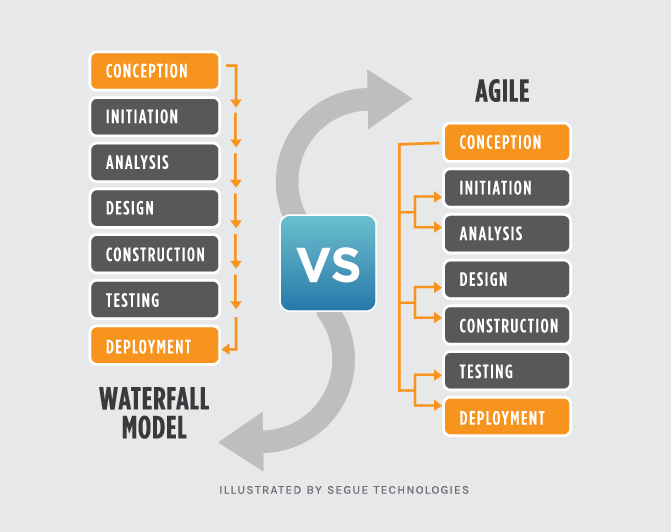
An effective solution came in the form of the Agile methodology. The agile methodology was quick, flexible, and easy to implement. The agile methodology advantages were in plenty as compared to the waterfall methodology. This method was instantly approved and applied by many organizations across the world. The agile methodology basics were applied to software project development processes. Unique solutions to modern-day problems were the manifesto of the Agile methodology. Its concepts and characteristics were implemented to make sure that projects don’t fail. As a result of this new methodology, many companies that were on the brink of collapse got a new lease of life and started creating better products. The Agile methodology advocates the use of constant monitoring tools to identify defects at the initial stages.
Brief Summary of the Agile Manifesto
The agile methodology for project management was brought about with a manifesto in the beginning. With the help of the manifesto, organizations were able to control their processes and create better project management methodologies. The agile methodology for beginners is not that difficult because it follows an easy to understand the process. These processes are further emphasized by the manifesto. The manifesto of the Agile methodology is explained below.
How is Scrum related to Agile Manifesto?
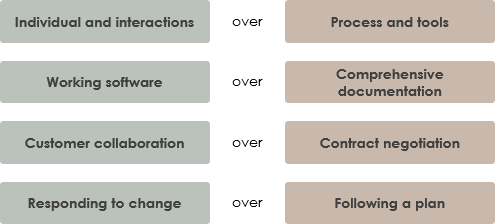
There are 12 principles of the Agile manifesto that every software development team must take into account. There are also certain values of the Agile methodology that must be taken into account while understanding the Agile methodology. Let’s take a look at some of the values first.
Values of the Agile Methodology:
- The agile methodology advocates the use of working and practical software and shuns the use of texts or documents that look good only on the paper. Being practical is one of the main values of the Agile methodology as it allows individuals to focus on the workable aspects of the methodology.
- Preferring individuals to processes. This is an important value. Often, companies undermine the importance of the human resources and only focus on the machinery and tools to decide things. This is a wrong approach as the greatest asset of any company is its manpower or human resource. When you consider human feedback as the biggest source of your adaptive changes, you will be able to adapt to problems quickly. Often machines miss out on key things that are only visible to a human eye. Therefore, considering the role of humans in a project management team is very crucial.
- Customers are the key drivers of the organization. An organization’s profits and losses depend on how well its products are received by the people. A product that is popular with the consumers will be more successful than the one that is less popular. The Agile methodology focuses on this aspect of the project management and ensures that companies get the best out of their resources.
- Be ready for changes and act fast in hard challenges. Be it at the office or home, there are always some guidelines or the other. These guidelines need to be flexible so that when new challenges emerge, organizations can deal with them quickly. The Agile methodology focuses on responding quickly to a change in plans. The traditional waterfall method left little scope for improvement. But, the Agile methodology is flexible and leaves wide room for improvement processes. This is the reason why a lot of companies are adopting the Agile methodology for their business processes.
Become Agile Certified Practitioner with PMI ACP Certification Training
Principles of the Agile methodology:
The Agile methodology documentation and design follows certain principles that will help an organization implement the agile methodology into their development processes. Read More

Comments
Post a Comment